
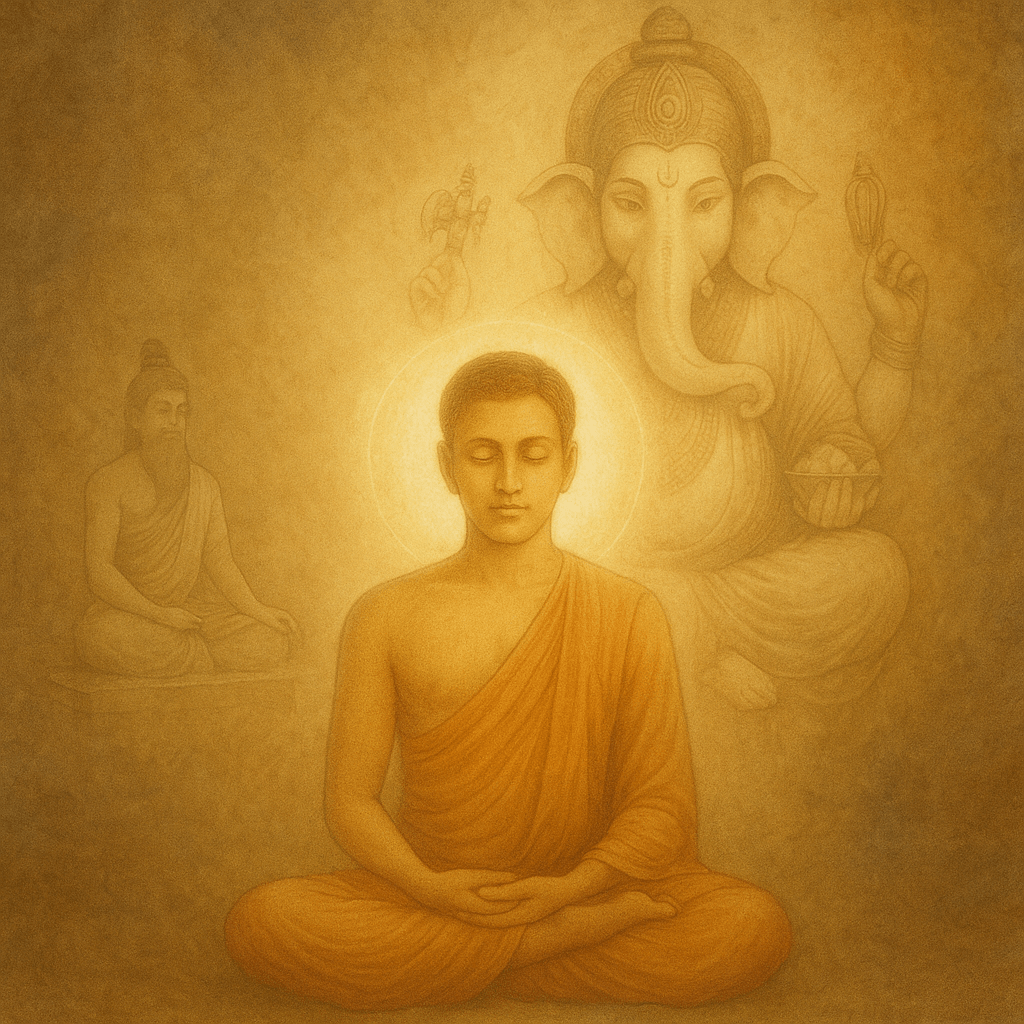
Today is Ganesh Chaturthi, a day when we honor the remover of obstacles, the one who clears the path to truth – Lord Ganesha. In South Indian tradition, one of the stories remembered in prayer is the tale of a nobleman man – Satrajit, Lord Krishna, and the lost Syamanthaka jewel.
As I reflected on the story, it felt like it is not just a story of a lost gem, but of the human mind and its restless waves.
The Jewel & the Doubt – A Story
Satrajit was a devotee of the Sun God, Lord Surya. As a blessing, the Lord Surya gave him a dazzling gem called the Syamanthaka jewel, which produced immense wealth every day. The gem was so bright that when Satrajit wore it, people mistook him for the Sun himself. Proud of the gem, he chose to keep it rather than share it with the kingdom.
Lord Krishna suggested that such a divine jewel should be presented to the king, Ugrasena, so that it could benefit the entire kingdom. But Satrajit refused, wishing to keep it for himself.
One day, his brother Prasena wore the jewel and went hunting, only to be killed by a lion. The lion was then slain by a bear king named Jambavanta, who took the jewel to his cave.
When Prasena did not return, Satrajit immediately accused Lord Krishna of murder and theft. Suspicion and imagination filled his mind. Lord Krishna, to clear his name, followed the trail, fought Jambavanta, and eventually returned the jewel. Satrajit was humbled after knowing what has happened. He realized his false accusations came from a restless, clouded mind.
As I read this story today, I saw how Satrajit was not just trapped by suspicion. He was caught in what Patanjali calls the five vrittis – the five modulations of the mind. Let us a take a look at what these are.
Five Modulations of the Mind (Vrittis)
In the ancient wisdom of Patanjali’s Yoga Sutras, the mind is compared to a calm lake. When still, it reflects truth with clarity. But when disturbed by wandering thoughts and shifting emotions, its reflection becomes distorted.
These ripples are the five modulations (vrittis) – the subtle currents of the mind that shape our experience of reality. At times they cloud our clarity. At other times they guide us toward understanding.
1. Right Knowledge (Pramana)
Patanjali defines pramaṇa as valid knowledge – truth that can be trusted. For knowledge to be valid, it must correspond to reality and not be based on illusion, error, or mere imagination. The mind naturally seeks proof or means of verification to establish that its knowledge is valid.
Patanjali explains that such proof comes in three ways: direct perception, logical inference, and reliable testimony.
Direct Perception (Pratyaksha)
Pratyakṣa is knowledge gained through direct experience of the senses. It is the most immediate form of knowing – seeing, hearing, touching, tasting, or smelling something directly. Because it comes from personal experience, it carries a strong sense of certainty. Yet even perception can be mistaken if the senses are clouded by conditions like poor lighting, distraction, or bias. True pratyakṣa requires clear attention and awareness.
Example: You smell smoke in your kitchen and recognize something is burning.
Logical Inference (Anumana)
Anumana is knowledge gained through reasoning and drawing conclusions. It connects what is directly known to what must logically follow. This form of knowledge allows the mind to extend beyond immediate perception, piecing together clues to reach deeper understanding. However, inference depends on the accuracy of the premises – if the starting point is flawed, the conclusion will also be false.
Example: Seeing smoke rising from a hill in the distance and inferring that there must be fire. Or, noticing dark clouds and concluding that rain is likely.
Scriptural/Testimonial Authority (Agamah)
Agamah refers to knowledge received from reliable sources – such as sacred texts, trusted teachers, or experts. Since we cannot directly perceive or logically infer everything, we often rely on testimony to guide us. When the source is trustworthy, this knowledge can be a powerful foundation for understanding and growth. However, if the authority is unreliable or misunderstood, it can also lead to blind belief or error. Thus, Patanjali emphasizes the importance of discernment in choosing what voices we trust.
Example: Accepting that Mount Everest is the tallest mountain because you trust geographers, or learning spiritual truths from a teacher whose wisdom you respect.
2. Wrong knowledge (Viparyaya)
Wrong knowledge is a false understanding of reality. It occurs when we mistake illusion, assumption, or personal projection for truth. The mind interprets based on past impressions or emotions and overlays them onto what we perceive. This distortion can lead to misunderstandings, misjudgments, and conflict. Recognizing viparyaya is essential, because it reminds us how easily the mind can be deceived when it takes appearances at face value.
Example: Mistaking a rope in dim light for a snake and reacting with fear, or assuming a colleague dislikes you because they didn’t greet you, when in reality they were simply preoccupied.
3. Imagination (Vikalpa)
Imagination arises when the mind creates ideas or images without a direct basis in reality. It can take the form of fantasies, daydreams, or fears that have no grounding in the present moment. While imagination can be a source of creativity and inspiration, it may also lead us astray when mistaken for truth. Unchecked, it can stir unnecessary worry or false hope, clouding the mind’s ability to see clearly.
Example: Lying awake at night imagining noises in the house are signs of an intruder, when in fact it’s only the wind. Believing a friend is upset with you simply because they haven’t replied to your message quickly, even though nothing is actually wrong.
4. Sleep (Nidra)
Not Just “Nothing”
Patanjali explains that sleep is not just “nothing happening” in the mind. Instead, it is a special state where the mind rests in blankness. In deep, dreamless sleep, our usual mental activities – like perceiving, imagining, or remembering – are silent. What remains is what Patanjali calls the “cognition of nothingness.”
Example: When you wake up and say, “I slept deeply, but I don’t remember anything,” that is nidra – a state where the mind experienced blankness.
The Paradox of Sleep
- For the body and brain, sleep is profoundly healing. It repairs tissues, balances energy, consolidates memory, and clears the nervous system. That is why, after good sleep, we feel refreshed and alert.
- For the deeper mind (awareness), ordinary sleep is tamasic. Awareness is covered, not clear. Sleep restores functionality but does not give insight.
From Sleep to Yoga Nidra
From a yogic perspective, the goal is not to stop sleeping but to bring awareness into it. This practice is called yoga nidra – “yogic sleep.” In yoga nidra, the body rests as in sleep, but the mind stays awake and aware.
Important note: Patanjali does not suggest replacing ordinary sleep with yoga nidra at night. Normal sleep is essential for health. Yoga nidra is a practice that trains awareness, showing us that even in rest we can remain conscious.
Beyond Sleep: Turiya
Yogis describe a “fourth state” called turiya. Turiya is simply pure awareness – always present, but usually hidden behind waking, dreaming, and sleeping. Ordinary sleep gives rest, but yoga nidra can open the doorway to this higher state.
5. Memory (Smriti)
It preserves what the mind has seen, heard, and felt. While memory can serve as a valuable guide – helping us learn, recognize patterns, and make wise choices – it can also cloud our perception of the present.
Pleasant memories may create attachment, while painful ones can stir fear or aversion. In either case, the mind may not see reality as it is but rather through the coloring of past impressions.
Example: Avoiding an opportunity because a previous attempt ended badly, even though the present situation is different. Meeting someone new but instantly liking or disliking them because they remind you of a person from your past.
Mind Modulations: Clear vs Clouded
Let’s take a look at how these modulations impact us when we are mindful versus when we are clouded
| Right Knowledge (Pramaṇa) | |
|
When Mindful (Unafflicted) Using perception, reasoning, or reliable testimony to navigate life wisely. It keeps us grounded in reality and prevents us from being misled. Example: Checking directions on a map before a trip. Verifying facts before making a judgment. |
When Clouded (Afflicted) Becoming overly dependent on proof and logic, demanding that everything – even truth, God, or love must be “proved.” Forgetting that proof belongs to logic, and logic has limits. Example: Refusing to believe in love unless it can be scientifically measured, or demanding logical proof of God before accepting the possibility of the divine. |
| Wrong Knowledge (Viparyaya) | |
|
When Mindful (Unafflicted) Awareness and discernment guard against misconception. You pause before concluding, check facts, or stay curious instead of assuming. Example: Instead of thinking “They ignored me,” you ask, “Maybe they’re busy – let me find out.” |
When Clouded (Afflicted) Misinterpreting someone’s actions. “They ignored me.” → “They hate me.” Letting that false belief create fear, doubt, or resentment. |
| Imagination (Vikalpa) | |
|
When Mindful (Unafflicted) Harnessing imagination creatively—for vision, inspiration, problem-solving, or storytelling. Example: Visualizing a project, dreaming of possibilities, enjoying stories. |
When Clouded (Afflicted) Mistaking imagination for reality. Worrying about things that don’t exist. “What if I fail?” “What if I get sick tomorrow?” |
| Sleep (Nidra) | |
|
When Mindful (Unafflicted) Nidra gives the body and brain deep rest, restoring energy and balance. With yogic practice, it can be transformed into yoga nidra – a state where the body sleeps but awareness stays awake. For advanced yogis, this conscious rest opens the doorway to turīya, the fourth state of pure, steady awareness that is beyond waking, dreaming, and ordinary sleep. Example: Getting 7–8 hours of refreshing sleep and waking up energized. Practicing yoga nidra to rest the body while keeping awareness alert. |
When Clouded (Afflicted) Nidra turns heavy and tamasic. Oversleeping or using sleep as an escape leads to dullness, lethargy, and avoidance. Instead of refreshment, it clouds awareness and binds the mind in inertia. Examples: Sleeping late into the day and waking up groggy. Using sleep to avoid stress or problems, only to wake feeling heavy and unclear. |
| Memory (Smriti) | |
|
When Mindful (Unafflicted) Remembering lessons and joyful experiences that guide wise choices. |
When Clouded (Afflicted) Reliving past trauma or regrets so strongly that they color the present – keeping one bound in fear, anger, or longing. |
Let’s pause for a while. Notice your breath, notice your thoughts – observe what’s happening in your mind, how they make you feel.
The Five Modulations in the Story
The five modulations of the mind map perfectly onto Satrajit’s doubt. In the tale of the Syamantaka jewel, the trouble was never the gem itself. The unrest arose from the restless waves of the mind. Satrajit was pulled by each of the vrittis, and they clouded his vision.
Instead of relying on true perception and inquiry, he ignored pramaṇa and leapt to conclusions. Caught in viparyaya, he believed Krishna was guilty without evidence, a classic misconception. His vikalpa fueled the mind further, spinning stories: “Krishna must want the jewel.” Spiritually asleep in nidra, he could not recognize Krishna’s divinity and purity. And his smriti, tied to wealth and past impressions of greed, distorted his judgment even more.
The Same Waves in Our Lives
Why do misunderstandings arise even between people who love each other? Why does the mind keep spinning with worry about the future or regret about the past? Because these same vṛittis still rule us today:
- We misinterpret words and actions (viparyaya).
- We imagine scenarios that never exist (vikalpa).
- We sleep through the truth right in front of us (nidra).
- We drag old pain into new moments (smriti).
The jewel of peace is never truly stolen by the world. It is only hidden when the mind’s waves grow restless.
Bringing the Five Vrittis into Daily Life
The story of the Syamantaka jewel reminds us that the mind’s movements shape how we see the world. By becoming aware of these vṛttis, we step back from confusion and return to clarity. Few ways to notice and practice:
- Viparyaya (Misperception)
- Notice when you assume, misinterpret, or jump to conclusions.
- Practice by pausing and asking: What do I actually know for sure? This opens space for truth to emerge.
- Vikalpa (Imagination)
- Notice when your mind spins stories or worries that aren’t grounded in reality.
- Practice by gently reminding yourself: This is just a thought, not the truth.
- Smriti (Memory)
- Notice when past experiences color how you see the present.
- Practice by asking: Am I responding to what’s here now, or through the lens of the past?
- Nidra (Sleep)
- Notice when your awareness slips into blankness, zoning out, drifting, or losing clarity.
- Practice by bringing yourself back with a breath, a stretch, or mindful attention to the moment.
- Pramana (Right Knowledge)
- Notice when your mind seeks certainty in what you believe to be “true.”
- Practice by checking: Is this based on direct perception, sound reasoning, or trustworthy guidance? Let clarity steady the mind without clinging to it.
The jewel of clarity isn’t outside us, it shines within when the mind is steady, like a calm lake.
The Way Out
Let’s now from noticing to working with the mind.
Patanjali says: Yogaś citta-vṛtti-nirodhaḥ
Yoga is the stilling of these distortions of mind. When the vṛttis are stilled, the mind is clear like a calm lake. Then there is no scope for doubt, fear, or misunderstanding – only direct perception of truth. Patanjali does not leave us with only the diagnosis of the restless mind; he also offers the cure.
Abhyasa (Steady Practice)
The steady effort to return the mind to the present, again and again.
Vairagya (Dispassion/Detachment)
The art of neither clinging to nor rejecting the vrittis. When we simply notice them without aversion or craving, they lose their grip and naturally fade away.
In this unfolding, the mind becomes a mirror-like lake – undisturbed by waves, open to truth.
Everyday Life (Traffic)
Imagine you are driving in heavy traffic. Thoughts start spinning: “I’m going to be late… why is this person so slow… this is unbearable!”
- With abhyasa, you gently bring the mind back: noticing your breath, staying with the act of driving, being present.
- With vairagya, you allow the frustration to arise but don’t cling to it; you let it pass without fueling it further.
Inner Life (Meditation)
While sitting to meditate, your mind drifts, replaying a conversation, imagining tomorrow’s tasks.
- With abhyasa, you bring the awareness back to the mantra, the breath, or the silence, again and again.
- With vairagya, you don’t fight the thoughts or judge them. You simply let them pass like clouds drifting across the sky.
The outer traffic and the inner traffic both remain but your relationship to them changes. You are no longer tossed by the waves of the vrittis.
Practice and letting go help untangle the mind. Freed from the grip of its five modulations, the mind becomes fresh, quiet, and clear. When we’re no longer caught in constant overthinking, worry, or old habits, the mind feels lighter and clearer. In that calm, our best self naturally comes through.
Closing Reflection
The greatest obstacle is not outside in the world or in others, but in the restless patterns of our own mind. The real jewel is not something we find outside, but the clear and steady mind within.
Satrajit’s suspicion reminds us of what happens when vrittis rule us. Krishna’s detachment shows us what happens when the vrittis are stilled.

May we find clarity of mind, freedom from inner obstacles, and the joy of discovering the jewel that has always been within us.
 Synthesis
Leave a comment