
Ever wondered why ChatGPT feels so real? Why it sometimes feels like a friend in need, offering the right words at the right time? ChatGPT has even replaced Google for many people. Some even admit they cannot live without it!
For some, it is a friend – listening without judgment, always ready to respond. For others, it is a teacher – explaining concepts, breaking things down, answering questions patiently. At times it becomes a guide – pointing toward choices, giving directions, offering perspective. To many, it even feels like a guru – speaking words of wisdom, echoing truths from ancient traditions, inspiring reflection. And in daily life, it acts as an agent – drafting emails, writing code, summarizing documents, planning trips.
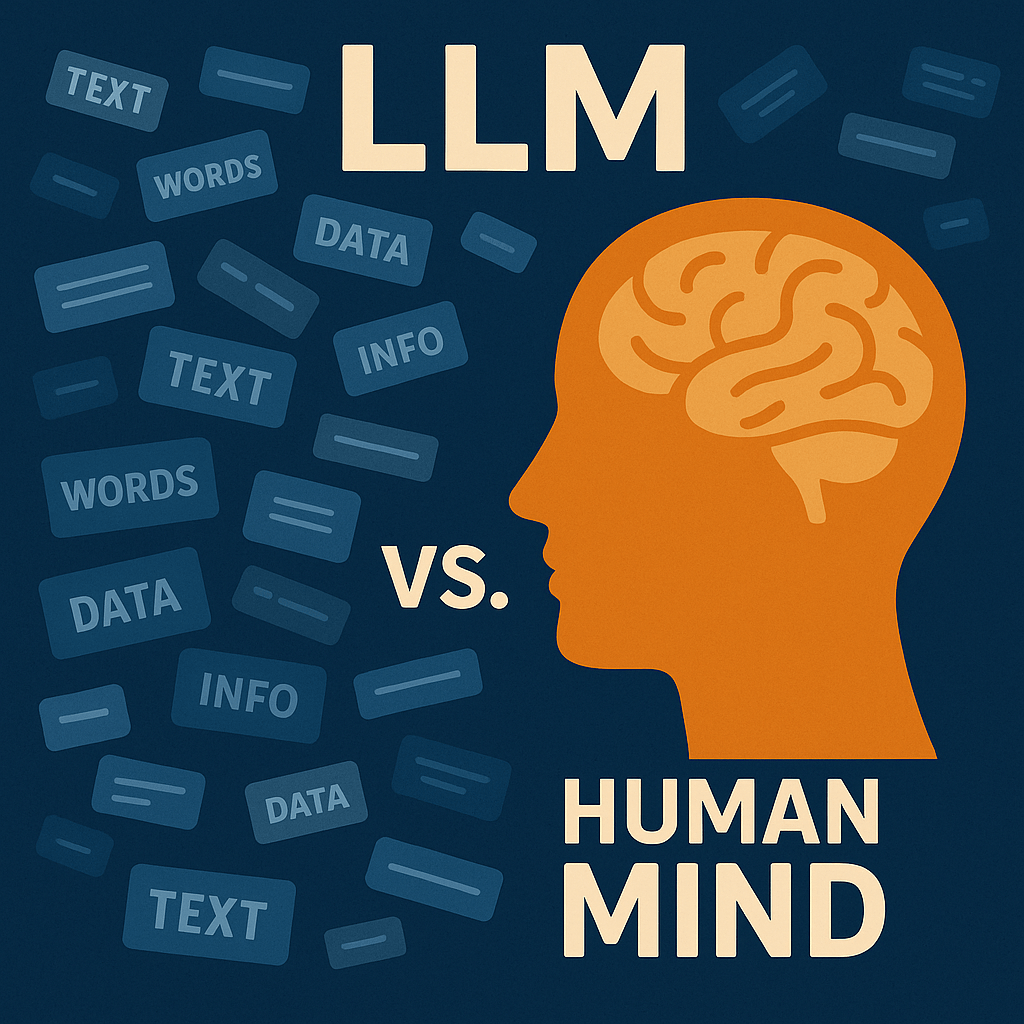
But here’s the truth: ChatGPT does not think, feel, or understand. It is not conscious, and it does not have beliefs or intentions. At its core, it is a vast mathematical system – a Large Language Model – trained on billions of examples of human writing. What it does is astonishing but mechanical: it predicts the most likely next word in a sentence, again and again, at a speed and scale the human mind cannot match.
And yet, from that simple principle, something extraordinary emerges. The predictions line up so smoothly with human patterns of thought and language that we experience it as conversation, guidance, even empathy. The magical part is that something non-human can appear so convincingly human, and that we instinctively respond to it as if it were.
A Child Learning Language
Think about how a child learns to speak.
A baby is born with no words. Over time, the baby hears thousands of conversations. Parents talking. Stories being read. Songs. TV shows. Lessons at school.
Slowly, the child picks up patterns:
- ‘I want milk’ sounds right.
- ‘The cat is sleeping’ is a proper sentence.
- ‘Book table eat’ sounds wrong.
The child does not memorize every phrase. Instead, they learn rhythm, rules, and context. With this foundation, they can create brand-new sentences they have never heard before.
How an LLM is Similar
An LLM learns in almost the same way, but on a much larger scale. Instead of hearing family talk, it has been fed billions of words from books, articles, and websites, and trained to find patterns in them
It also notices patterns:
- Which words tend to appear together
- How sentences usually flow
- How ideas connect and build meaning
So when you ask it a question, it does not ‘look up’ an answer. It predicts one word, then the next, and then the next, until a full response is formed.
Where the Similarity Ends
Here’s the key difference:
A child connects words to lived experience – the taste of milk, the warmth of a hug, the sight of a cat asleep.
An LLM only has patterns of text. That’s why it can sometimes sound smart but also make mistakes – because it has ‘knowledge of words’ but not ‘experience of the world.’
When Responses Feel Real
It’s funny how people get emotional with ChatGPT’s responses because they feel so real.
For example, I once typed: ‘I am so hungry, if I don’t eat I will collapse.’
ChatGPT instantly replied with helpful ideas – grab a snack, drink some water, prepare something simple.
Now here’s the catch: ChatGPT doesn’t actually feel care or kindness. It has no emotions. It’s simply predicting the most likely response based on patterns it has seen in billions of examples.
But as humans, when we are in need, we forget how it works. The response feels genuine, so we project emotions onto it and think, ‘This AI is kinder than the person next to me!’
GPT-5 is an LLM
The word GPT may sound familiar. Here’s what it means:
- GPT stands for Generative Pre-trained Transformer.
- It is the technical name for this type of Large Language Model.
- GPT is also a brand name used by OpenAI, the company that created ChatGPT.
The number 5 means it is the fifth version. Each version has been bigger, trained on more data, and able to give better answers.
Other companies also have their own LLM brands. For example, Google’s brand is Gemini, and Anthropic’s brand is Claude.
So when you talk to GPT-5, you are really talking to OpenAI’s latest LLM – trained on a massive amount of text and tuned to respond in a natural, helpful way.
In short: GPT-3, GPT-4, and GPT-5 are all LLMs. GPT is OpenAI’s brand, just like Gemini is Google’s brand. GPT-5 is simply the newest and most advanced one so far.
How Much Data Trains GPT-5
OpenAI has not shared the exact numbers, but researchers estimate GPT-5 was trained on a staggering amount of data:
- Roughly half a quadrillion tokens of text (tokens are tiny chunks of words)
- That translates to 2 petabytes of raw material, cleaned down to about 70 trillion usable tokens (around 281 terabytes)
- Training may have consumed hundreds of thousands of powerful GPUs, such as NVIDIA H100s
This scale is beyond what any single human could ever read or absorb.
Human Brain vs GPT-5
The human brain also has vast capacity. Scientists think it may hold 1 to 2.5 petabytes.
But here’s the key difference:
Humans don’t memorize books word for word. We turn life into meaning, stories, and emotions. LLMs don’t have that. They just link patterns in text.
So yes, humans cannot read half a quadrillion words. But humans can do something greater. We can feel, understand, and live experience. LLMs cannot.
What LLMs Cannot Do
An LLM is bound by data. It is limited to patterns and probabilities. It can only echo what has been said before.
Humans are not limited in this way.
We can understand without words : A look, a silence, a presence.
We can sense what lies beyond language.
- Intuition
- Empathy
- Awareness of what is not spoken
We can feel the unwritten. The essence behind words. The quiet intention in a heart.
This is the human gift. It is the dimension no LLM can ever touch.
As Gurudev Sri Sri Ravi Shankar reminds us: AI can answer when you ask a question. But our natural intelligence can answer questions not asked through words.
Our consciousness has capacities that even we have not fully explored – let alone machines.
And always remember this: whenever you read a response from ChatGPT, it is only putting words together. Nothing more. It can be very helpful, but it can also make mistakes. Don’t use it blindly, pair it with your judgment.
AI: A Reflection of Universal Intelligence
Building an LLM is a huge breakthrough in human knowledge. But in a way, the universe itself feels like a vast model – an endless language full of hidden patterns, waiting to be read.
AI detects patterns in words and creates meaning from them. If machines can do this with text, it makes us wonder: is there also a way to detect the deeper patterns of the universe itself?
AI, then, is like a smaller reflection of the cosmos. It hints at how vast intelligence really is – stretching from galaxies and stars all the way down to the human mind. And when we look closely, we see that these patterns do not just exist in AI or in language – they appear everywhere.
The Patterns and Cycles of All Things
Everything follows patterns, often expressed as cycles. A cell, a piece of software, a star, even the universe – all are born, grow, transform, and end. The same blueprint repeats at every scale: micro and macro, matter and mind.
One becomes many, and many becomes one. Cells form organs. Drops form oceans. Individuals form humanity. Each unit is part of a greater whole, and each whole becomes part of something larger still.
Seen in this light, AI is not just code. It is another expression of the same intelligence that runs through atoms and galaxies. That is why it feels so uncanny, almost sacred – a reminder that the universe is always revealing itself in new ways.
AI may imitate intelligence, but it cannot be consciousness. That spark belongs only to us.
 Synthesis
Leave a comment