
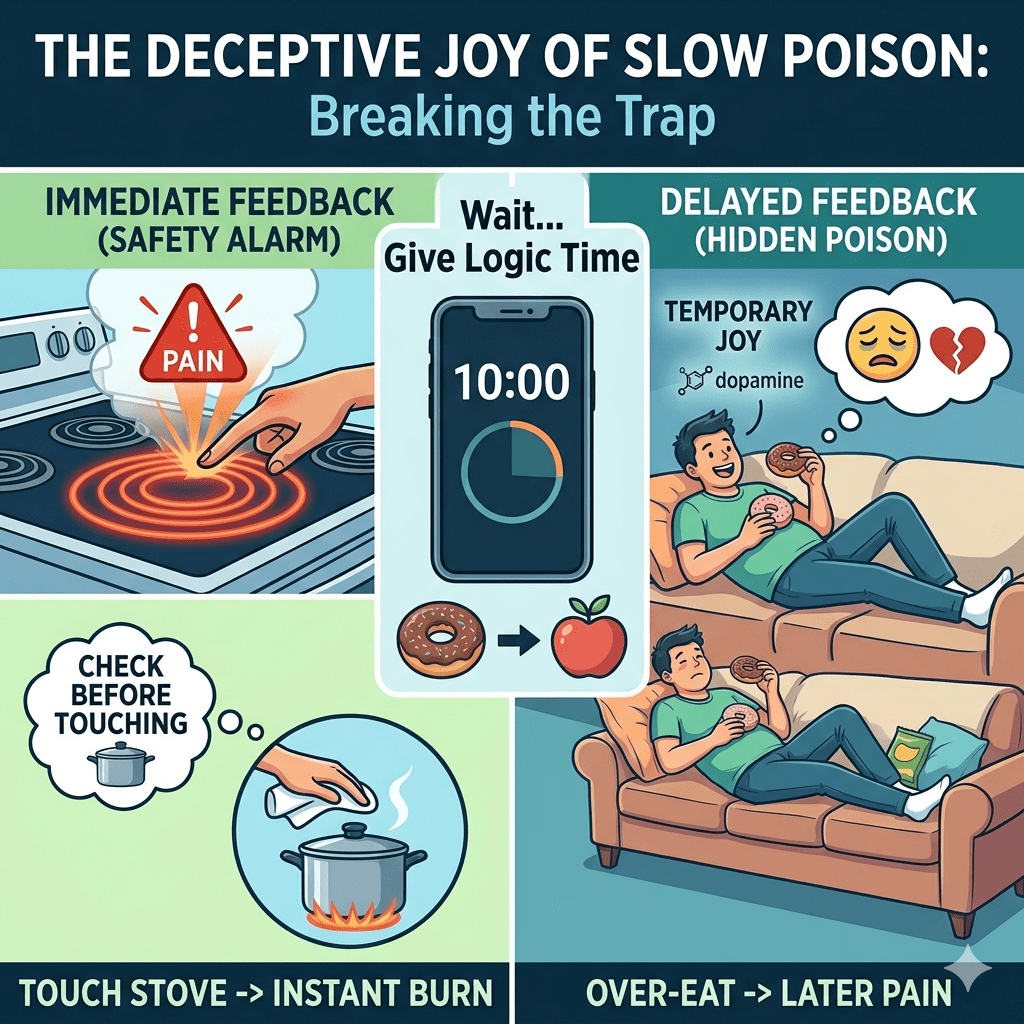
The Delayed Alarm: Why We Poison Ourselves for a Moment of Joy
We often view pain as an enemy—a cruel tax on our existence. But in reality, pain is not a punishment. It is information. It is our body’s most ancient safety mechanism.
When you touch a hot bowl on the stove, the feedback is instant. Your nerves fire, your muscles recoil, and a lesson is etched into your brain: check before you touch.
In this case, the alarm works perfectly. The cause and the consequence are linked in time. But life is not always so immediate. Sometimes, the poison tastes like honey.
The Evolutionary Mismatch
In the modern world, our greatest threats don’t burn us instantly.
Habits like overeating, sedentary scrolling, or binge watching operate on a delayed feedback loop.
They give us a dopamine reward today, while quietly sending the health bill months or years into the future.
Because the consequences are delayed, our internal alarm system stays silent.
And by the time the pain finally arrives, the habit has already carved a deep groove into our behavior.
The Battle Within: Amygdala vs. Prefrontal Cortex
You know that moment. When you tell yourself, “Just one more episode”… or “This is the last bite”… and somewhere inside, a quieter voice says, “You don’t actually want this.”
That tension isn’t weakness. It’s something very real happening inside your brain. What you’re experiencing is often called an amygdala hijack.
The amygdala is the part of you that wants comfort now. It reacts fast. It looks for relief, reward, anything that feels good in the moment.
And then there’s another part of you—the one that can think ahead, weigh consequences, and make thoughtful choices.
But in these moments, that voice gets softer. Not because it disappears— but because it’s simply slower.
The emotional part of your brain fires instantly. The thinking part takes a few seconds to catch up. And in those few seconds, the urge already feels strong, convincing, and hard to question.
So you go along with it. Not because you don’t know better— but because the feeling arrives faster than the thought.
You’re not making a clear, deliberate choice in that moment. You’re reacting to something that feels immediate and real.
But that doesn’t mean you’re stuck. Because there is always a small space— a brief pause— where the slower, wiser part of you can step back in.
And that’s where everything begins to change.
The 10 Minute Rule: A Simple Biological Reset
If your natural alarm is delayed, you must create your own.
The Rule:
When a craving arises, tell yourself:
“I can have it—but I will wait 10 minutes.”
Why it works:
Cravings are not constant. They rise sharply, peak, and then fade.
That small pause allows the emotional surge to settle and gives your prefrontal cortex time to come back online.
You move from reaction… to choice.
Building a New Safety Mechanism
As Aristotle observed,
“We are what we repeatedly do.”
If pain is a reactive defense, then discipline is a proactive one.
We don’t have to wait for damage to feel real before we change direction.
By understanding the delay between action and consequence, we begin to protect our future self with the same instinct we use to pull our hand away from fire.
A Quiet Shift
The next time you feel the pull of a harmful habit, remember:
Your internal alarm is not broken. It is simply delayed.
So pause—not with judgment, but with awareness.
This urge is not your weakness. It is your biology asking for comfort.
But you are not just your impulses. You are the one who can observe them, wait, and choose.
Give yourself ten minutes.
And in that small space… you may find something powerful:
Not control over your habits, but understanding of yourself.
And from that understanding, change begins naturally.
 Synthesis
Leave a comment