
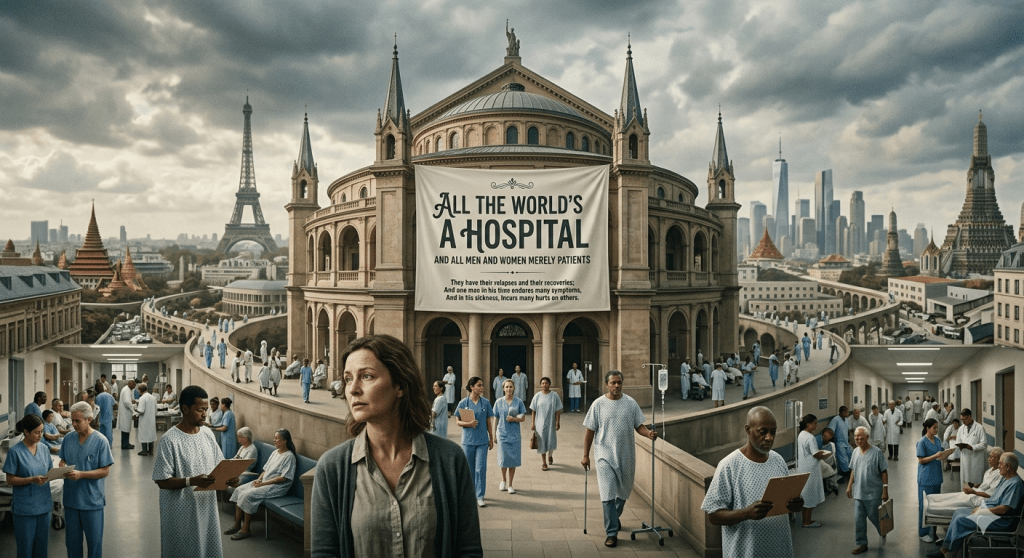
In Act II of As You Like It, William Shakespeare famously penned the lines:
“All the world’s a stage,
And all the men and women merely players;
They have their exits and their entrances,
And one man in his time plays many parts…”
Shakespeare continues by describing the seven stages of life—the infant, the schoolboy, the lover, the soldier, the justice, the “pantaloon” (old man), and finally, “second childishness.” It is a beautiful image of life as a performance, but for those who have looked deeper into the raw reality of human nature, another sharper truth emerges.
I say: All the world’s a hospital, and all men and women merely patients…
The Rahu Diagnosis
Shakespeare saw “players” acting out roles, but if we look through the lens of the cosmic astrological chart, we see something different. In every person’s life, Rahu—the shadow planet of insatiable hunger—sits somewhere.
Psychologically, Rahu represents our “unquenchable loop.” It is the obsession that drives us when we are not conscious. Because of this, we aren’t just actors; we are individuals suffering from a “mental sickness” rooted in karmic desire.
We are born into this world-hospital because we have a condition that requires surgical intervention. We aren’t here to perform; we are here to be cured.
The Contagion of the Mind: Hurt as a Symptom
There is a fundamental asymmetry in human suffering that Shakespeare’s “stage” ignores:
Physical sickness is solitary. If a man has a broken leg, he alone feels the throb. He does not break the legs of those standing near him.
Mental sickness is a contagion. When a person is driven by an obsession—be it power, validation, or a fixation on a partner—they become a “carrier.” A “player” on a stage doesn’t necessarily hurt the audience, but a patient in the world-hospital infects everyone in their ward. One person’s anxiety becomes a family’s unrest; one leader’s paranoia becomes a nation’s fever.
By using Shakespeare’s exact rhythm, the truth becomes even more striking:
All the world’s a hospital,
And all the men and women merely patients;
They have their relapses and their recoveries,
And one man in his time endures many symptoms,
And in his sickness, incurs many hurts on others.
The Scorpion and the Rose
Like a scorpion that stings because it is its nature, or a rose that pricks those who handle it unskillfully, obsessive people make everyone around them “sick” with anxiety, resentment, or despair.
We often spend our lives complaining about these “stings,” but that is where we lack skill. You cannot complain that a scorpion stung and killed someone—it is its nature. You must simply develop the skill not to be hurt by it.
Pain as the Medicine
In Shakespeare’s theatre, the end is “oblivion” – a fading out into nothingness. In the World-Hospital, the end is Transformation.
We are on this planet to be treated via the surgery of experience. The “stings” we receive from others and the “thorns” of our own Rahu-driven obsessions are the surgical tools of the universe. They are designed to break our delusions. Pain is not a punishment; it is the medicine required to wake us up from our specific type of insanity.
The Path to Vairagya
True Vairagya—the birth of spiritual dispassion—begins when you realize that this “sickness” is a permanent feature of the human condition. It will never go away through external fixes.
Once you develop the skill to see the world as a hospital:
• You stop expecting “health” (perfection) from a ward full of patients.
• You stop trying to “fix” the scorpion and start protecting your own peace.
• You view the “symptoms” of others with compassion rather than resentment.
The Prognosis: We are not here to win an Oscar for our performance. We are here as patients, undergoing the painful treatment of life and the shared burden of each other’s symptoms. We remain in the ward until we are finally transformed enough to be discharged into the clarity of truth.
Reflection: Today, when someone “stings” you with their behavior, don’t ask “Why are they doing this to me?” Ask, “What symptom am I witnessing?” Observe the ward, protect your peace, and focus on your own recovery.
 Synthesis
Leave a comment