
The Dream of Perfect Love
Almost everyone, at some point in life, longs for unconditional love. We want to feel fully accepted by someone—beyond our mistakes, moods, fears, and imperfections. We dream of a love that never changes, never pulls away, and never keeps score.
But without realizing it, we may be asking another human being to rise above the very nature of being human. What begins as a deep wish for love can slowly turn into an expectation that becomes heavy for both people.
The Human Mind and Conditions
The human mind is not bad or selfish. It is just trying to protect itself. It remembers hurt, reacts to pain, compares situations, and constantly thinks about safety, respect, and emotional balance. Somewhere deep inside, most minds carry a quiet question: “What about me?”
Sometimes we experience moments that feel completely pure—holding a baby, caring for someone who is suffering, or loving someone so deeply that for a moment we expect nothing back. In those moments, love feels effortless and unconditional.
But human emotions do not stay the same all the time. The moment we feel ignored, hurt, misunderstood, or taken for granted, something changes inside us. We become distant, protective, or reactive. Not because we are bad people, but because the mind naturally moves toward protecting itself again.
The Mind Keeps Changing
There is another layer to this that we rarely notice. Even when we say we want unconditional love, that longing itself is not always constant. Human needs, emotions, and desires keep changing from moment to moment.
At one stage of life, we may deeply crave someone’s presence, understanding, and endless patience. But later, the same mind may move on, seek something different, or no longer value what it once desperately wanted.
And this is where pain often enters relationships. One person may still continue giving with the same intensity, while the other person has already changed internally. What once felt meaningful can suddenly feel excessive, unneeded, or even emotionally heavy.
That is why unconditional giving between human minds can sometimes feel misunderstood or wasted—not because love itself is wrong, but because the human mind is constantly changing.
Lessons from Nature
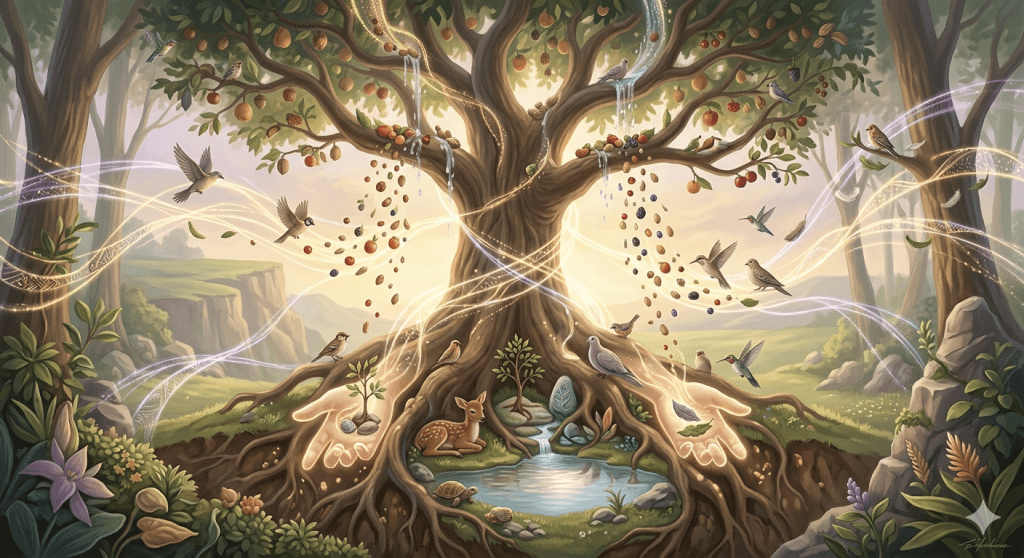
If we quietly observe nature for a while, we notice something very different from the human world. A bird builds its nest, the tree supports it, and the wind passes through both. Nothing is trying to control anything. There is no keeping score, no expectation, and no constant thinking about who is giving more.
The tree does not need appreciation, and the bird does not ask for permission to belong there. Everything simply exists together naturally. Maybe that is why nature feels so peaceful to us.
Nature does not seem to carry the constant “what about me” that so often exists in the human mind.
Living in the Human World
Human relationships are different. Most of us naturally expect something in return, even if we do not say it openly. Care wants care back. Effort wants to be noticed. Even silence can carry meaning.
We must face a simple truth: much of the human world operates through exchange, whether spoken or unspoken.
To see this clearly is not to become cynical. Seeing this clearly does not make love meaningless or fake: it is to become free. It simply makes us more understanding. We stop demanding the infinite from the finite.
We no longer measure every gesture or feel wounded when someone responds from their own limitations. We begin to see people not as sources of perfect love, but as fellow travelers moving through the patterns of their own minds. We stop taking every reaction personally and begin to understand that everyone is carrying their own fears, wounds, and limitations.
In that acceptance, relationships become lighter and more real.
Looking Within
True love is not an emotion to be felt or a feeling to be caught; it is an ancient, inherent nature. It is the very fabric of our being that existed long before the mind began its calculations.
As Guruji teaches, to find the love we long for, we must stop looking outward at the transactional landscape and instead close our eyes and turn inward.
When we turn inward, we move past the “what about me” filter and touch the silence where love resides as a state of existence, rather than a reaction to another.
In that stillness, it becomes clear that what we were searching for in others was never meant to be sustained by them. Not because they failed, but because they are human.
Freedom from Expectation
The human mind will always react, protect itself, and sometimes pull away when hurt. Once we truly understand this, we stop demanding impossible perfection from people.
Relationships do not become less meaningful after this realization. If anything, they become more real, softer, and more compassionate.
The kind of unconditional love we dream about is not something to expect from ordinary human minds. It is something you may glimpse in an enlightened being like Sri Sri Ravi Shankar or discover within your own self when you move beyond the limitations of the ego.
Until then, maybe the wisest thing we can do is this: love people sincerely, give what we can wholeheartedly, but stop expecting another human being to fill every emptiness inside us. Do not place that expectation on others.
The moment expectation drops, love is no longer a burden. It becomes a freedom you live from, not something you wait to receive.


Leave a comment