
On the invisible boundaries of compassion
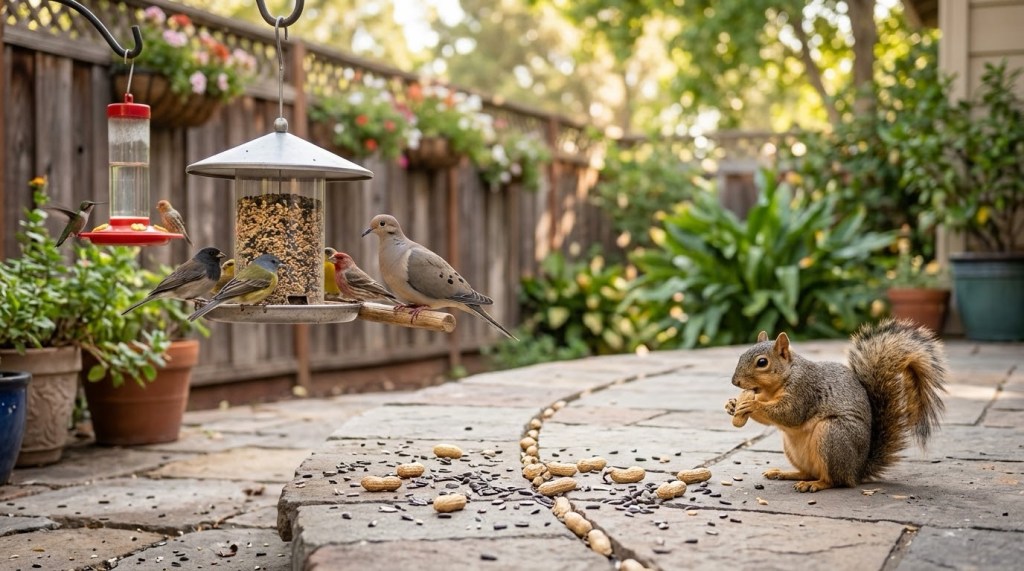
For many days, I had been observing something within myself that bothered me. I had somehow developed a very clear attitude toward the little creatures visiting my patio: my birds, not my squirrel.
I wanted to protect the birdseed from the squirrels so the birds could eat. But when I really thought about it, there wasn’t much logic behind my preference.
The birds could find food elsewhere. The squirrels could find food elsewhere. Neither had any greater claim over the seeds I had bought. It was simply my preference.
And that made me curious. Why had my heart drawn a circle around the birds and left the squirrels outside it?
Where Preference Begins
My bird feeding began with hummingbirds. I had heard how frequently they need to eat, and something about imagining these tiny creatures constantly searching for nectar touched me deeply.
Around the same time, I witnessed something I could not easily forget. Two baby doves fell from a nest and died in front of me.
I don’t know whether that was the root of everything that followed, but after that I began hearing the chirps of baby birds differently. Their begging calls immediately caught my attention. I watched parents bring their babies to the patio, watched the little ones flutter behind them, beg for food, slowly learn to eat and eventually become independent.
When those babies grew into fledglings and disappeared, I missed them. I never wanted to keep them. They belonged to the sky. But their charm brought smiles to my heart.
I began learning about them, observing their behaviors and personalities, and finding little lessons about life—and about myself—in their everyday lives.
Feeding them became a responsibility, but one I was happy to take on for the company they gave me unconditionally. Or perhaps that is simply how I saw it. 😄
Looking back, I think this is important. My preference for the birds did not come from compassion alone. They gave me something too: beauty, company, tenderness, joy. I had formed an emotional relationship with them.
Somewhere along the way, without realizing it, they had become my birds.
When “Mine” Creates “Not Mine”
Then came the squirrels.
At first it was simply chaos. They climbed things I thought they couldn’t climb, found ways around things supposedly designed to stop them, knocked things over, and seemed to treat every new obstacle as another engineering problem waiting to be solved.
Then one day, a squirrel climbed onto the patio perch where a mourning dove was resting and attacked it, knocking the dove down. Thankfully, the dove was able to fly away and didn’t appear seriously hurt.
But something changed in me that day. The squirrels didn’t seem cute anymore. Now they were threatening something I loved.
I became even more determined to keep them away. Protecting the birds wasn’t the only reason. Unlike the birds, I had no particular affection for the squirrels, and that made their presence and the mess they created much harder for me to accept.
And yet, even after chasing a squirrel away, I would sometimes find myself wondering, Did it find food somewhere else? I hope it did.
I didn’t want it to starve. I just didn’t want to be the one feeding it.
That contradiction stayed with me. I cared about its hunger, yet I still wanted it to find its food somewhere else. My compassion hadn’t disappeared. It had simply drawn a boundary.
Nature Has Its Own Ways
Meanwhile, the more I watched the birds, the harder it became to maintain my neat categories of innocent birds and troublesome squirrels.
Birds knock one another away from food. They fight over territory. Some eat insects and other living creatures; some species prey upon other birds. Nature was not arranging itself according to my ideas of good behavior.
The squirrel wasn’t plotting against my birds. It was hungry. There was food, and it wanted the food.
And one morning, something in me finally gave up the fight.
When the Boundary Moved
Instead of finding another way to keep the squirrels away, I put out peanuts and sunflower seeds for them.
I placed the food on the patio early in the morning, before the birds normally arrived. The idea was simple: let the squirrels eat first. Let them have enough that they didn’t need to fight for the birdseed or disturb the doves. They could eat peacefully and leave before the birds came.
It felt almost funny after all the effort I had spent trying to outsmart them. The solution was not another barrier.
It was a handful of peanuts.
For the first time, the squirrels could come to my patio and find food placed specifically for them. They didn’t have to steal it. They didn’t have to fight for it. They didn’t have to fear me chasing them away.
And I found myself thinking:
Why can’t I just give them what they want and let them be?
Something about that question went much further than squirrels.
What had really changed that morning?
The squirrels were the same squirrels. The birds were the same birds. I would still protect a dove if a squirrel attacked it. I still didn’t want the squirrels taking over the bird feeder.
What had moved was not the practical boundary. It was the boundary inside me.
Until then, without consciously deciding it, I had divided these creatures into those whose hunger concerned me and those whose hunger was an inconvenience. The birds had entered the circle of my affection. The squirrels had remained outside it.
Nothing about the squirrel had changed. Something in me had.
When Life Recognizes Life
There is another small experience on my patio that keeps bringing me back to this.
I leave a tray of fresh water outside for the birds. Sometimes I watch a bird arrive thirsty, stand at the edge and drink. It dips its little beak into the water, lifts its head, swallows, and drinks again.
And strangely, my own thirst seems to disappear.
I actually feel a cooling sensation inside me.
The bird drank the water. Why do I feel quenched?
There may be a perfectly ordinary explanation. Perhaps watching another living being’s need being satisfied creates such relief in me that my own body responds. I don’t know.
I don’t particularly need to know.
For those few seconds, there is thirst, there is water, and the thirst is quenched. Somehow the contentment doesn’t seem to belong entirely to the bird or entirely to me.
Maybe somewhere beneath all these separate bodies and separate lives, life recognizes life.
Who Belongs Inside the Circle?
That experience has stayed with me because, like the squirrels, it makes me wonder about the boundaries I draw between one life and another.
I have spent years contemplating oneness—the one existence expressing itself through countless forms. Yet it took something as ordinary as the creatures on my patio to show me how easily I still divide that existence into mine and not mine.
And isn’t this something we human beings do everywhere?
Our family, our people, our community, our beliefs, our country, our side.
Compassion comes naturally when someone is vulnerable, beautiful, familiar or emotionally connected to us. It becomes much harder when another being inconveniences us, competes with us, frightens us or threatens something we love.
Perhaps universal compassion does not begin with forcing ourselves to love everyone equally.
Perhaps it begins by noticing where our compassion stops.
The Circle Begins to Dissolve
This doesn’t mean that boundaries in life should disappear. If a squirrel attacks a dove, I will still protect the dove. I don’t have to allow every creature into my home or feed every animal that appears at my door.
But I am beginning to understand that a boundary in action does not have to become a boundary in the heart.
I can say ‘not here’ without saying ‘not you’.
And perhaps that is what the squirrels were quietly teaching me.
Not that I must feed every creature. Not that I should abandon boundaries. Not even that I must feel the same affection for a squirrel that I feel for a little bird whose chirping has become familiar to me.
Only that I should look carefully whenever my heart begins drawing a circle and deciding who belongs inside it.
The birds were never mine.
The squirrels were never outsiders.
It is easy to recognize oneness in something we love. Perhaps the deeper practice is recognizing it in something we would rather chase away.
I may still protect the birdseed. I may still chase a squirrel away when necessary. And I may still smile more when a tiny junco appears than when I see a squirrel plotting its next engineering breakthrough. 😄
The squirrel does not belong to me. Its hunger is no different from mine. We do not have to possess another life to recognize our shared existence in it.
And perhaps the question the squirrels left me with has very little to do with squirrels at all.
Where else in my life have I drawn a circle around what is mine—and who have I quietly left outside it? ❤️


Leave a Reply