
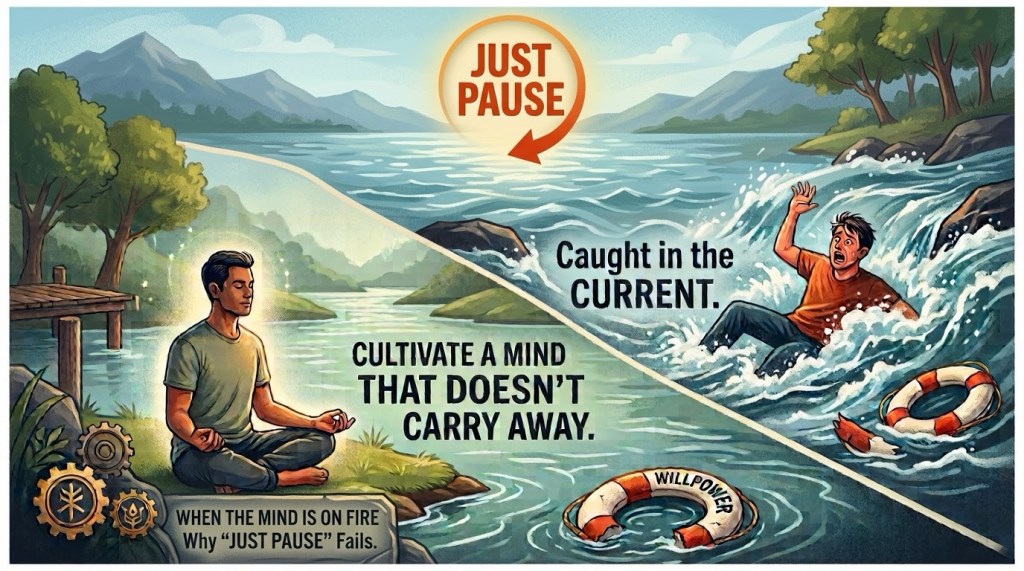
We have all heard the advice: when you are angry, pause. Take a deep breath. Count to ten. Don’t send that message immediately. Don’t speak when emotions are high. It is good advice. Sometimes, that small pause can save a relationship, prevent a terrible decision, or stop us from saying something we may regret for years.
But when emotions have already taken over, is it really that easy to pause?
When We Need the Pause the Most
Imagine someone who is mildly irritated. They feel the irritation rising and recognize it. Somewhere inside, there is still enough awareness to say, I am getting angry. Let me not react right now. That person may be able to pause.
But now imagine someone who is deeply stressed, wounded, fearful, anxious, obsessed with a situation, or emotionally feverish. Their heart is beating faster, their body is tense, and their mind is already preparing the next sentence. At that moment, they may not think, I am losing control. They may think, I am absolutely right. Their mind gives them a hundred reasons why they must speak, defend themselves, send that message, make that call, or settle the matter right now.
And this reveals something important: the moment we most desperately need a pause may be the very moment when creating that pause is the hardest.
Knowing Is Not the Same as Being Able
Most of us already know far more than we are able to practice. We know anger can damage relationships. We know worrying for another five hours will not solve tomorrow’s problem. We know we shouldn’t send an emotional message in the heat of the moment. We know we shouldn’t allow someone else’s behavior to occupy our mind all day. We know we should let go.
And yet sometimes we don’t. Then, after the anger or anxiety passes, another kind of suffering begins. I knew better. Why did I still react? I meditate. I have read so much. Why do I still get disturbed? After all these years, why haven’t I changed? Sometimes the anger passes, but the guilt stays.
But struggling to pause in an intensely emotional moment does not necessarily mean that everything we have learned or practiced has failed. When the mind and body are highly activated, access to the very awareness we need can become much more difficult. We are still responsible for what we do, but responsibility does not require us to condemn ourselves afterward.
Perhaps instead of asking, What is wrong with me? we can ask, What happens within me before I lose that space?
Instead of blaming ourselves for the reaction, we begin to understand what leads us into it.
The Person in the Current
When the mind is calm, wisdom is easy to understand. When the mind is feverish, that same wisdom can become difficult to access. It is like standing safely on the shore and telling someone caught in a powerful current, Just stand still. They may understand perfectly well what you mean, but the current is already carrying them.
Much of our advice about self-control is given from the shore: pause, think rationally, don’t react, let it go. All of it may be true. But perhaps we are asking willpower to rescue us at precisely the moment when willpower is hardest to access.
Usually, we try to intervene at the very end of the process. The anger has already become intense. The worry has already occupied the mind. The body is tense and the thoughts are racing. And at precisely that moment, we ask ourselves to suddenly become calm, rational, and disciplined.
Sometimes we can. Sometimes we cannot.
So instead of asking only, How do I control myself when I am overwhelmed? perhaps there is a deeper question: How do I cultivate a mind that is not so easily overwhelmed in the first place?
One approach tries to control the reaction after it has become powerful. The other works on the inner condition from which the reaction arises.
Working From Within
This is where pranayama, meditation, awareness, and contemplation take on a much deeper meaning. They are not merely emergency techniques to remember after the mind has already become disturbed. Practiced regularly, they work from within.
We are not simply training ourselves to remember, I should remain calm. We are cultivating the mind and nervous system so that we are not carried away quite so easily in the first place.
The change may be subtle. Anger still comes, but perhaps it does not rise quite as quickly. Worry still comes, but we recognize sooner when the mind has started circling the same thought again and again. Someone may still hurt us, and the hurt may be completely real, but somewhere between that hurt and our response, the smallest hesitation can begin to appear.
That hesitation may not feel peaceful at all. The chest may still be tight. The hands may feel warm. The jaw may still be clenched. The mind may have the perfect reply ready. Every part of us may still want to act. But for one brief second, we notice what is happening before we obey it.
That one second is the beginning of space.
And sometimes that is all the pause asks of us – not to make the anger disappear, not to convince ourselves that we shouldn’t be hurt, and not to suddenly become calm. It may simply mean being willing to stay with an uncomfortable feeling for a little while without immediately turning it into an action.
If we can remain with that discomfort even briefly, something can begin to change. The intensity may start to come down. What felt as though it demanded an immediate response may no longer feel quite so urgent. The message that seemed absolutely necessary to send right now may look different ten minutes later. The words we were certain had to be spoken may no longer need to be spoken at all.
We don’t have to resolve everything we are feeling. Anger can be present without becoming the next sentence. Hurt can be present without becoming the next message. Worry can be present without becoming another hour of thinking.
This is what makes that small space so powerful. It is not the absence of emotion. It is the beginning of freedom from having to obey every emotion.
Practice Before You Need the Practice
Perhaps this is why inner practices matter most before the difficult moment arrives.
We don’t strengthen the body on the day we suddenly need to lift something heavy. We strengthen it little by little beforehand. The mind may not be so different.
Every day of pranayama, every period of meditation, and every moment of becoming aware of what is happening within us, something is being cultivated.
We may not notice the change while it is happening. Then life gives us a similar situation again. Something that once disturbed us for three days disturbs us for three hours. Something that once consumed an entire day passes sooner. Something that once made us immediately reach for the phone happens again. The urge is still there, the words are still ready, and the emotion is still real – but this time, for one brief moment, we see it before we become it.
That is not a small change. That is where freedom begins.
The Deeper Meaning of Self-Control
Perhaps self-control is not becoming so disciplined that nothing can disturb us. Life will disturb us. People may hurt us. Fear will visit us. Anger will arise. There will be things we desperately want to control and simply cannot.
The deeper work is not to become emotionless. It is to cultivate an inner state in which every emotion no longer automatically becomes our master. Then pranayama is not merely breathing when we are angry. Meditation is not merely trying to calm ourselves when the mind is restless. Awareness is not merely watching thoughts. Together, they point toward something deeper: an inner freedom in which we can feel fully without being carried away by everything we feel.
And slowly, something beautiful can change. The pause no longer has to be something we desperately try to remember in the worst moment. It begins to arise from what we have cultivated within ourselves long before that moment arrives.
Perhaps the deepest self-control is not the strength to stop ourselves at the very last second. It is becoming inwardly free enough that, when that second arrives, there is already some space within us to choose.


Leave a comment