
On compassion, impermanence, and the quiet cycles of the human heart
When One Small Life Filled My Days
Not very long ago, a little bird became part of my everyday life in a way I had never imagined.
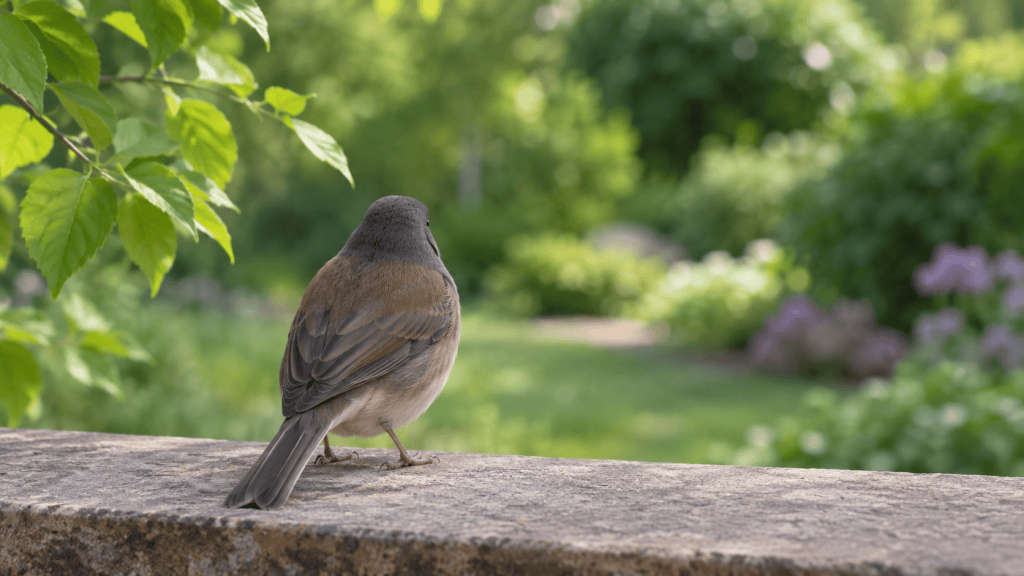
She was a dark-eyed junco, one of the many wild birds that visited my patio. But unlike the others, something was terribly wrong with her. Large, disturbing growths had developed around her eyes. Her belly appeared unusually swollen, and she moved slowly, pausing frequently while the other birds hopped around with effortless energy.
I didn’t know what illness she had, whether she was in pain, or how much she could see. But looking at her, I couldn’t escape the feeling that this little life was struggling.
And somehow, her suffering entered my world.
My mornings began with thoughts of her. I would look through the window, searching for that familiar little figure on the patio wall. When it rained, I wondered where she was sheltering. At night, I hoped she had found somewhere safe and dry to rest.
Whenever she appeared, I would prepare a small tray of seeds, breaking the sunflower seeds into smaller pieces so she could eat more easily. I kept the other birds away while she ate and removed the tray afterward.
She would stand there, eating quietly, sometimes hardly reacting to my presence. Then she would fly away, disappearing into the trees and the world beyond my patio. I would watch her leave, hoping she would manage until the next time I saw her.
Soon, helping this little bird became much more than putting out food. I contacted wildlife rehabilitation centers, spoke with animal control, shared photographs and videos, and searched for ways to get her examined. I even purchased a birdcage, hoping she might voluntarily enter it so I could safely take her for professional care.
But with every possibility came another uncertainty.
Taking her to rehabilitation might give her a chance to recover. It might also expose her to the fear of capture and unfamiliar surroundings. Leaving her alone would preserve her freedom, but perhaps also leave a treatable illness untreated.
I found myself questioning not only what I should do, but what it meant to act compassionately when I could not know the outcome.
For days, this tiny bird led me into questions about suffering, karma, responsibility, and the strange contradictions of existence.
I was so occupied with wondering what would happen to her that I never considered what would eventually happen to my own feelings.
The Bird Disappeared. Then Something Else Began to Disappear
One day, the junco stopped coming.
At first, I continued looking for her. I checked the patio, watched the wall where she sometimes appeared, and wondered whether she might return with the other birds. A day passed, then another, but there was no sign of her.
Perhaps she recovered and found another place to feed. Perhaps she moved beyond the places I could see. Perhaps her illness worsened, and she died somewhere in the wild.
I still don’t know.
Eventually, I returned the cage I had purchased for her.
There is something unsettling about how ordinary such an act can be. A cage is bought because a living creature might need help. Days later, the same cage is returned because that creature has disappeared.
The purchase could be undone. The uncertainty could not.
I had no answers about her condition, no reassurance that she was safe, and no way of knowing whether I would ever see her again.
Yet life continued.
Gradually, I stopped checking the window so often. I stopped waking up with the immediate thought of whether she had eaten. When the rain returned, my mind no longer went straight to that little bird somewhere outside.
At first, I was still aware of her absence. Then even that awareness began to fade. There were days when I barely thought about her.
Nothing had happened to resolve my concern. No one had called to tell me she was healthy. I hadn’t learned what became of her.
The uncertainty remained. But the urgency I once felt about it was disappearing.
Then, one day, I began thinking about her again.
I remembered the growths around her eyes, her slow movements, the way she stood on the tray, and how sincerely I had wished for her to recover. As the memories returned, so did the emotions.
For a few moments, I could feel that familiar concern again. And then a strange question arose within me.
Was that it?
All those hours of worrying, searching for answers, making phone calls, and hoping for her well-being. All that intensity, all that compassion.
Could something that had moved me so deeply simply fade from my mind within a few days?
I hadn’t witnessed her recovery or learned what had happened to her. I hadn’t even said goodbye. Nothing had been resolved.
Yet, without my deciding to, I had begun to move on.
And that realization troubled me more than I expected.
How What Once Meant Everything Becomes a Memory
As I reflected on this, I began to recognize the same pattern throughout human life.
Think of someone you once spoke with every day.
There was a time when you knew almost everything happening in their life. You knew what made them happy, what worried them, and what they were going through. Something interesting would happen, and they would be the first person you wanted to tell.
Then life changed.
Perhaps you moved to different places. Perhaps the relationship changed. Perhaps there was a misunderstanding, or perhaps nothing particular happened at all.
The conversations became less frequent. At first, you noticed the silence. You might have looked at your phone, expecting a message that didn’t arrive. You might have started typing something, then decided not to send it.
Months later, you realized that you had stopped expecting those messages altogether.
Their number was still in your contacts. Your old conversations were still there. But they were no longer part of the daily rhythm of your life.
Or think of a person who is no longer alive.
For a while, you may instinctively reach for the phone to tell them something, only to remember that you cannot. Their favorite cup may remain in the cabinet. A familiar expression, a song, or an ordinary household sound may unexpectedly remind you of them.
Years pass, and perhaps you still love them deeply. Yet there are entire days when you don’t think of them.
Then one afternoon, you come across something small, something you would once have overlooked, and suddenly an entire world returns. A memory, a voice, a feeling you thought had disappeared.
For a moment, the distance between past and present seems to vanish. You remember not only the person but also who you were when they were part of your everyday life.
And then the moment passes.
What fascinates me is not simply that relationships change. It is that our minds gradually adjust to the absence of someone who once seemed inseparable from our lives.
We rarely recognize this while we are living through an experience. When someone matters deeply, the feeling seems almost permanent. We cannot imagine that the person who occupies our thoughts today might eventually become someone we remember only occasionally.
Yet the mind has a remarkable ability to reorganize itself around what is present, even when what is absent once meant everything.
Sometimes that ability is comforting. Sometimes it is deeply unsettling.
The Uncomfortable Truth About Forgetting
There is a side of moving on that we don’t often talk about.
We celebrate healing. We admire resilience. We encourage people to let go of the past and continue living.
But there is something quietly unsettling about how effortlessly we forget.
It reveals that even the things we consider precious are not guaranteed a permanent place in our daily awareness.
We may promise ourselves that we will never forget someone. And perhaps we never entirely do. But over time, the details begin to soften. A voice becomes harder to recall. The exact words of a conversation disappear. The little habits we once knew so intimately become blurred around the edges.
Sometimes we discover that a memory has faded only when we try to retrieve it. That realization can bring an unexpected sadness, almost as though we are losing something a second time.
And perhaps the most uncomfortable part is that we don’t always resist the fading.
We become busy. We laugh at something new. We make plans, respond to messages, discover new interests, and become absorbed in the ordinary demands of life.
The world continues presenting itself to us, and we continue responding.
Meanwhile, something that once occupied so much of our inner world becomes quieter and quieter.
There is something almost disloyal about how naturally this happens. Not because moving on is wrong, but because the ease with which we resume our lives can seem so unlike the depth of what we once felt.
When I realized that I had gone several days without thinking about the junco, I was surprised by how ordinary those days had been.
Somewhere, perhaps, she was still struggling. Perhaps she was no longer alive. Yet I had returned to my routines, attended to my responsibilities, and thought about entirely different things.
Her fate remained unknown. My life had continued without knowing it.
That is a difficult truth to sit with.
The junco did not become less deserving of compassion because I stopped thinking about her. Her condition had not necessarily improved simply because my concern had faded.
The world had not become less uncertain. I had simply become less occupied by its uncertainty.
Perhaps this is what unsettled me most.
The feelings had changed, but nothing about her situation had necessarily changed with them.
Does the Fading of Compassion Make It Less Real?
The more I considered the fading of my concern for the junco, the more I began to question what makes compassion genuine.
The bird really did visit my patio. I really did prepare food for her, watch her eat, seek professional advice, and try to understand what might help.
Those actions were real. So was the concern that inspired them.
Something does not have to last forever to have been real.
A mother does not need to worry about her child every moment for her love to be genuine. A friend does not need to remember us every day for the friendship to have mattered.
But there is another important distinction.
Feeling compassion is not the same as acting compassionately.
We may be deeply moved by another being’s suffering and still do nothing. We may love someone yet fail to express that love while we have the opportunity.
And even when we act, good intentions do not guarantee good outcomes.
That was the dilemma I faced with the junco. Capturing her might have helped her receive treatment, but it might also have frightened or injured her. Leaving her alone avoided those immediate risks, but might have meant missing a chance to relieve her suffering.
Compassion required more than feeling deeply. It required discernment, the willingness to consider what might genuinely benefit her rather than simply relieve my own distress.
I could not know the outcome. I could only try to act thoughtfully with the information available.
And now that the experience has passed, I am beginning to understand something else.
I do not have to preserve the same anguish to prove that my concern was sincere.
The kindness happened when it happened.
The Strange Mercy and Cost of Impermanence
There is a reason the mind’s ability to move on can be a blessing.
Imagine carrying every sorrow you have ever experienced with the same intensity you felt when it first happened.
The grief of losing someone, the helplessness of watching a loved one suffer, the disappointment of a relationship ending, the fear that accompanied a difficult moment. Imagine all of it remaining equally vivid, every day, for the rest of your life.
It would be almost impossible to live.
Perhaps our ability to gradually release emotional intensity is one of the ways we remain capable of welcoming new experiences.
A person grieving a loss may eventually find themselves laughing at dinner and then feel surprised, even guilty, that laughter was possible. Someone who once could not bear to enter a particular room may one day sit there comfortably, with no sudden ache.
The memory remains, but the suffering no longer fills every available space.
The heart makes room.
Yet the very capacity that allows us to recover from pain also allows us to become accustomed to what was once precious.
We stop noticing the familiar voice in the next room. We assume there will be another evening to have that conversation. We postpone visiting someone because there is always next weekend.
Sometimes it is only after the ordinary routine disappears that we understand how much of our happiness was quietly hidden within it.
This is the contradiction of impermanence.
It takes away what we wish could remain, but it also softens what we thought we could never endure. The same mind that helps us survive loss may also allow us to overlook what we have not yet lost.
There is mercy in the fading of pain, and there is sadness in the fading of remembrance.
Neither truth cancels the other.
Perhaps wisdom lies not in resisting change or demanding that our emotions remain as intense as they once were, but in understanding what this double-edged truth asks of us.
If our time with everything is limited, then our attention while it is here becomes precious.
Not because we must hold on more tightly, but because we may not always have the chance to notice, appreciate, or respond.
What Remains When the Feeling Is Gone?
I still don’t know where my little junco is.
She may have recovered. She may have found a different place to feed. Her life may already have ended.
I hope, wherever she is, that she has been spared unnecessary suffering.
But I cannot turn that hope into certainty, and I cannot give her story an ending simply because I wish it had one.
For a brief time, she came into my world. I witnessed what appeared to be her suffering, tried to make food easier for her to find, and searched for ways to help.
Then she disappeared.
The other birds continued visiting. The rain fell. The mornings arrived. My routines resumed, and gradually the feelings grew quiet.
Yet something of the experience remained.
Before meeting this little junco, I had often reflected on compassion, suffering, and karma. But seeing her made those questions immediate. They were no longer distant philosophical ideas. They were present in the life of a small creature standing before me, eating a few seeds.
Her disappearance confronted me with something I hadn’t expected: the impermanence of my own compassion’s emotional intensity.
Perhaps I will never know whether my efforts made a meaningful difference to her life. But I know that her presence made me stop and look more closely at suffering. And her absence has made me look more closely at the mind that responds to it.
I cannot know whether that understanding will change how I act the next time I encounter a vulnerable living being.
That remains to be seen.
What fades is not necessarily what mattered. Sometimes it is only the intensity with which we once held it.
Knowing the Cycle, How Will You Live the Next One?
Think of someone who once occupied so much of your everyday life but whom you now remember only occasionally.
Perhaps there are messages you no longer open, photographs you rarely look at, or a familiar name that no longer appears in your daily conversations.
Once, those moments were your present. Now they are part of your past.
You may remember how intensely you felt, how much that person or experience mattered, and how impossible it once seemed that life could ever feel different.
But it did.
Somewhere ahead of you is another experience you cannot yet imagine. Another person you will come to love. Another unexpected joy. Another difficult decision. Another fragile life that may briefly cross yours.
Something will matter deeply again.
You will care, hope, worry, perhaps suffer. You will make choices without knowing how everything will turn out. And one day, that experience too will become a memory.
This is the cycle.
We encounter. We care. We become involved. We change. We let go, sometimes without even realizing we are doing it.
I used to think the important question was why our feelings fade.
Now I wonder whether recognizing that they will fade should change the way we live while they are here.
Perhaps we will never escape the contradiction. We are capable of caring deeply, yet incapable of preserving the intensity of that care forever. We long for permanence while living in a world where everything changes.
And still, another life will enter ours. Another moment will ask something of us.
So I leave you with one question.
When the next person, the next joy, the next sorrow, or the next vulnerable life enters your world, will the awareness of impermanence make you love less, or will it teach you to love more deeply while you can?


Leave a Reply