
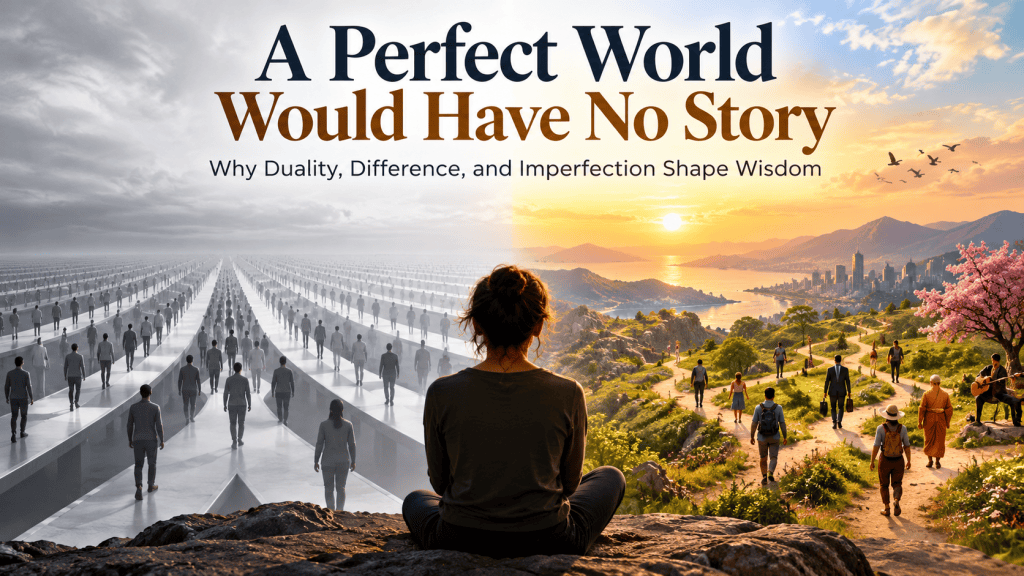
Why Duality, Difference, and Imperfection Shape Wisdom
What If Our Idea of Perfection Is Imperfect?
We dream of a perfect world. A world without conflict, jealousy, hatred, or suffering. A world where everyone is compassionate, understanding, peaceful, and wise. Where nobody hurts another, nobody misunderstands another, and everyone lives in harmony.
It sounds beautiful. Perhaps it is what humanity has been longing for throughout its existence. But have we ever stopped to ask what we actually mean by perfection?
We often imagine perfection through our own understanding of how life should be. We expect harmony, agreement, compassion, and wisdom, sometimes without recognizing how easily these expectations become standards against which we measure everyone else.
Must everyone see existence through the same eyes for the world to be perfect? If someone thinks differently, lives differently, or understands life differently, does that make them imperfect? Or does it simply mean that existence contains more possibilities than the ones we have come to recognize?
Perhaps what we call imperfection is sometimes nothing more than the presence of something different from what we expected. And perhaps the world is not always asking to be corrected. Sometimes it is our understanding of the world that is asking to expand.
Imagine a World Without Duality
Imagine a world filled with people exactly as you wish them to be. There are no fights, wars, or crimes. No jealousy, greed, hatred, or selfishness. Everyone loves unconditionally, and everyone is calm, balanced, and content.
Now imagine that everyone also thinks alike. Everyone agrees on what matters, what is right, what is beautiful, and how life should be lived.
There might be peace, but would there be diversity of perspective? If everyone already knew everything they needed to know, what would remain to discover?
Imagine watching a movie in which every character thinks the same way, wants the same things, and responds identically. There is no uncertainty, no unexpected decision, and nothing to resolve. Would there still be a story?
A story does not necessarily require violence or suffering. Love, discovery, creativity, and wonder can create extraordinary stories. But a story does require movement, possibility, and something not yet known.
Perhaps this is what makes existence so fascinating. Life does not reveal itself through a single perspective. It unfolds through countless forms, relationships, experiences, and possibilities.
A world without suffering may be a beautiful aspiration. But a world without difference would be something else entirely.
Why do we so often mistake difference for imperfection?
Who Decides What Is Imperfect?
Consider a tree growing crookedly. Someone looking for a perfectly straight tree may consider it defective. A bird nesting among its branches may find it ideal. The tree itself is simply growing according to the sunlight, wind, soil, and space available to it.
Where exactly does the imperfection exist? In the tree, or in the mind comparing it with an imagined ideal?
We do something similar with people. Someone is ambitious, and we think they are too attached to worldly success. Someone is contemplative, and we think they are not doing enough. Someone speaks too much. Someone remains silent. Someone moves quickly. Someone takes years to understand what appears obvious to us.
We observe a difference, compare it with our expectations, and sometimes call it a flaw. But difference, incompleteness, and harmful behavior are not the same thing.
A person choosing a different path is not necessarily lost. A person who does not share our understanding is not necessarily less conscious. At the same time, cruelty, injustice, and actions that cause suffering still require discernment and sometimes intervention.
Not everything that differs from our expectations needs correction. And not everything that exists must be accepted as right.
Once we decide that something is imperfect, we often feel compelled to change it. An expectation becomes a judgment, judgment becomes a desire to correct, and frustration arises when reality does not cooperate.
What began as a preference becomes an inner struggle.
Wisdom, Suffering, and the Middle Path
We often say that darkness teaches us the value of light, that loss teaches gratitude, and that suffering makes us wiser. Difficult experiences can indeed transform our understanding. But does wisdom necessarily require suffering?
A child can discover love through being loved. Compassion can develop through understanding another’s experience. Wisdom can emerge through curiosity, contemplation, and wonder, without requiring every lesson to arrive through pain.
Something can become meaningful through what we learn from it without having been necessary for that learning.
Life offers understanding through many experiences: joy and sorrow, harmony and disagreement, action and stillness, success and failure. No single experience contains the entirety of wisdom.
Consider a musical instrument. A string stretched too tightly may break, while a string left completely loose cannot produce the intended note. Music emerges when the tension is appropriate.
Life, too, asks us to recognize when something has become excessive, insufficient, or out of balance. Yet the middle path is not simply choosing a position halfway between two extremes. Between cruelty and compassion, wisdom does not ask us to be moderately compassionate. Between truth and dishonesty, clarity does not always lie in compromise.
Sometimes wisdom asks us to remain still, and sometimes it asks us to act decisively. We can care deeply without demanding control over every outcome, and act with conviction without allowing disagreement to consume us.
The center is not necessarily where we stand between two opposites. It is the clarity from which we respond to them.
Different Roles, One Existence
Life does not call everyone toward the same expression. Some are drawn inward toward meditation, contemplation, inquiry, and devotion. Others are drawn outward toward building, creating, leading, protecting, raising families, and sustaining society.
Some teach, some heal, some organize, and some discover. These are not necessarily higher or lower ways of living.
A life engaged in work, business, family, or responsibility is not automatically less conscious than a life devoted to spiritual inquiry. Action reveals what stillness may not, and stillness reveals what constant activity can overlook.
A tree does not need to become a river. Fire does not need to become air. Each contributes to the world through its own nature.
Consider how much our everyday existence depends on people whose lives are different from our own. Those who grow our food, build our homes, develop technologies, care for the sick, teach children, and sustain communities. Our lives are interconnected in ways we rarely stop to appreciate.
Those who turn inward are often supported by the work of those engaged in the outer world. And those who cultivate inner clarity may bring greater compassion, wisdom, and understanding into that same world.
The inward path is not higher. The outward path is not lesser. Each can become an expression of awareness, responsibility, and care.
Perhaps spiritual maturity begins when we stop measuring every life against the path we ourselves have chosen.
The Subtle Ego of Spiritual Understanding
There is a fascinating paradox in the spiritual journey.
As we begin to understand attachment, ego, impermanence, and the nature of the mind, we may develop a new expectation: that others should understand these things too.
We look at someone consumed by ambition and wonder why they cannot see beyond success. We observe someone becoming angry over a small matter and wonder why they cannot remain centered. We see people attached to relationships, possessions, or recognition and think life would be easier for them if only they understood what we understand.
Without realizing it, the very wisdom that was supposed to free us from judgment becomes a new reason to judge.
We may have released certain attachments, yet become attached to the idea that everyone should release theirs. We may speak of acceptance while struggling to accept that another person sees life differently.
Perhaps one of the most subtle forms of ego is the belief that our understanding of life should become everyone else’s understanding.
This does not mean we stop sharing wisdom or guiding others. It means recognizing that guidance and control are not the same thing. We can offer understanding without demanding agreement and recognize that our own understanding, however profound it may seem, may still be incomplete.
And here is another paradox. If different perspectives are part of human existence, our desire to change others is also part of that diversity. So wisdom cannot simply mean that we must stop trying to change anyone. That would become yet another expectation imposed upon life.
The deeper question is whether our actions arise from clarity or from an inability to accept that others may choose differently.
There are times to guide, intervene, protect, or speak. And times to allow another person the freedom to discover life through their own experience. Knowing the difference requires discernment.
Awakening Does Not End the Story
Imagine an actor performing on a stage. The actor knows the story is a play, yet brings sincerity, attention, and dedication to the role. Knowing that the role is not the entirety of who they are does not prevent them from performing wholeheartedly.
Perhaps spiritual awakening offers a similar possibility.
We can recognize the impermanence of our roles without abandoning them. A parent can love and care for a child. A leader can make difficult decisions. A person can build an enterprise, serve society, or pursue a meaningful goal.
Awareness need not diminish participation. It may transform the quality of participation.
We act with less attachment to the identity created by our actions. We care without insisting that everything unfold according to our expectations. We fulfill our responsibilities without believing that our role is the whole of our existence.
Perhaps awakening does not mean that the story must end. Perhaps it means we no longer mistake the story for the entirety of who we are.
And recognizing life’s larger movement does not mean remaining passive in the presence of suffering or injustice. When a house is on fire, we do not sit back and admire the role of fire in nature. We bring water.
Compassion may require intervention, responsibility may require boundaries, and justice may require courage. We can accept that something has happened while working to change what happens next.
We do not need to be at war with existence in order to respond to what needs our attention.
The Freedom of Letting Others Be
Imagine meeting someone who sees life very differently from you. You explain your perspective, offer reasons and experiences, and believe your understanding could help them. But they remain unconvinced.
Frustration begins. Why can’t they understand something that seems so obvious?
But what if the frustration comes not from their inability to understand, but from our expectation that they must?
This realization can transform everyday relationships. We can still disagree, maintain boundaries, and stand by our values without needing another person’s agreement to validate our understanding.
When someone is learning, we can offer patience instead of judgment. When someone chooses a different path, we can respect their freedom without abandoning our convictions. When life unfolds differently from our expectations, we can respond to what is actually happening rather than remain trapped in the picture we had created.
And when judgment arises, we can examine it. Are we seeing something genuinely harmful, or merely something different? Are we offering guidance, or demanding agreement?
Gradually, the need to correct everyone begins to loosen. We become more capable of seeing people as they are, rather than only through the expectations we hold for them.
And we can extend that same understanding toward ourselves. We do not need to become perfectly accepting, perfectly detached, or perfectly wise. Even our own expectations and reactions can be observed without turning them into another reason to criticize ourselves.
We are learning, too.
Perhaps the Question Was Never About the World
We began by imagining a perfect world. But somewhere along the way, the question itself began to change.
We spend so much of our lives wanting people to think differently, behave differently, understand more, and live according to what we believe is right. We want circumstances to unfold in ways that make sense to us. And when they do not, we begin to feel that something is wrong.
An expectation becomes a judgment. Judgment becomes a desire to change what we see. And when reality does not conform, we struggle against it.
These are not separate burdens. They are often expressions of the same attachment: the belief that life should unfold according to our understanding of how it ought to be.
There is nothing wrong with wanting a more compassionate world or working to make it better. We can act without trying to control everything, guide without expecting agreement, and recognize what needs to change without believing that everything different from us is wrong.
And then something extraordinary becomes possible.
The world may remain exactly as it was. People may continue to think differently. Life may still unfold in ways we never expected. But the mind that was constantly measuring, comparing, and finding something wrong with everything begins to change.
Perhaps the deeper awakening is not discovering how to make the world perfect, but realizing how much of life we have been unable to see because we were so occupied with how we thought it should be.


Leave a comment